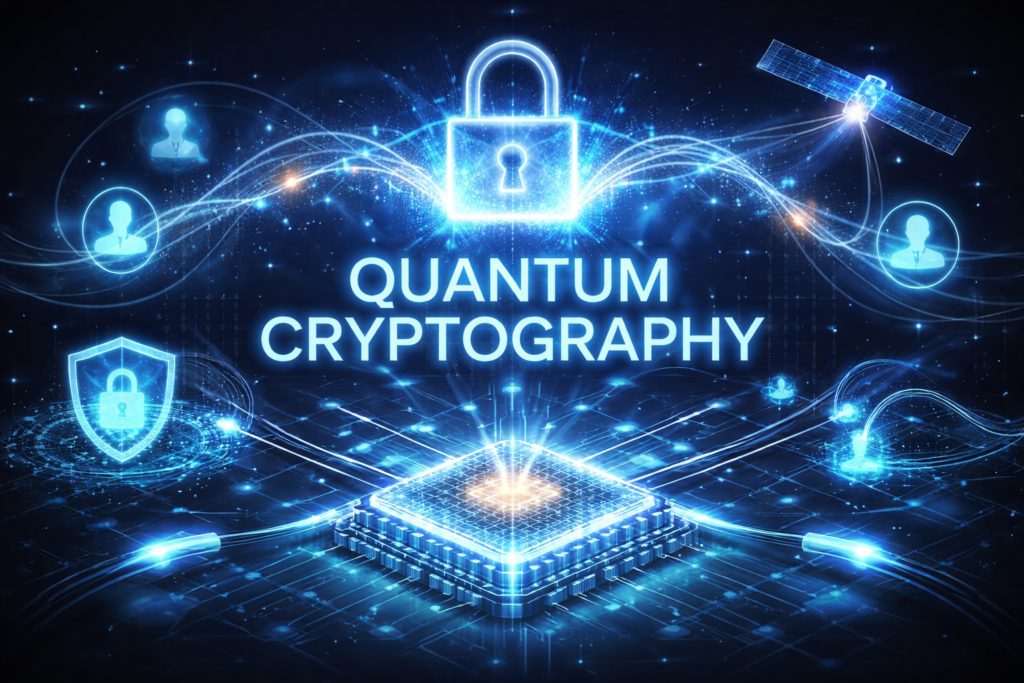
Quantum Cryptography is a next-generation method of securing data using the laws of physics. It uses quantum mechanics to protect information from hackers and cyber threats. In simple terms, it ensures that any attempt to intercept data is immediately detected.
As cyberattacks increase worldwide, traditional encryption is becoming vulnerable. This advanced form of quantum encryption offers a future-ready solution for global digital safety. It is already being tested in countries across Asia, Europe, and beyond.
What Is Quantum Cryptography and Why Does It Matter Today?
Quantum Cryptography uses principles of quantum mechanics to secure communication. It relies on particles like photons to transmit information safely. Any attempt to observe these particles changes their state instantly.
This makes it nearly impossible for hackers to steal data unnoticed. Unlike traditional encryption, it does not depend only on complex math. It uses the laws of physics, which cannot be broken.
Today, global businesses and governments are exploring this technology. From Mumbai to New York, digital security is becoming a top priority.

How Does Quantum Encryption Work in Simple Terms?
Quantum encryption works by sending data through quantum particles. These particles behave unpredictably when observed, ensuring secure communication between two parties.
Step-by-Step Process of Quantum Encryption
- Sender transmits a key using photons – The key is encoded into the quantum state of photons.
- Receiver reads the quantum state of each photon – The receiver measures the photons to decode the key.
- Intrusion detection – If a hacker tries to intercept the photons, their quantum state changes.
- Immediate alert – Both parties detect the intrusion instantly.
This method makes communication extremely secure and reliable. It is considered one of the strongest forms of encryption available today.
Why Is Quantum Security Important for the Future Internet?
Quantum security protects sensitive data from advanced cyber threats. Traditional encryption systems may fail against future quantum computers, which can break current methods quickly.
Preparing for Future Risks
Quantum Encryption ensures:
- Safe banking transactions
- Secure healthcare data
- Protection of personal and private information
It is essential for preparing the internet against future cyber risks and maintaining trust in digital communication.
For more tech insights, explore our guide on Local LLMs, which explains how AI can work securely offline.
What Are Quantum Cryptographic Systems and How Are They Used?
Quantum cryptographic systems combine hardware and software to secure data. They use specialized devices to transmit quantum keys. These systems are already being tested worldwide.
Common use cases include:
- Secure government communications
- Financial transactions and banking systems
- Military and defense data protection
- Healthcare data privacy
Countries like China and the USA are investing heavily in this technology. Global trends show increasing adoption across industries.
What Is Quantum Key Distribution and Why Is It Revolutionary?
Quantum key distribution (QKD) is the core of Quantum Encryption. It allows two parties to share a secret key securely. This key is used to encrypt and decrypt messages.
The biggest advantage of QKD is its security. If someone tries to intercept the key, it gets corrupted. This alerts both users immediately.
Key benefits of QKD:
- Detects eavesdropping instantly
- Provides unbreakable encryption
- Works over long distances with quantum networks
This makes it a game-changer for global communication systems.
How Does Quantum Computing Security Impact Current Encryption?
Quantum computing security addresses the risks posed by quantum computers. These machines can solve complex problems faster than traditional computers. This includes breaking current encryption methods.
This creates a major challenge for cybersecurity experts. Many existing systems may become obsolete in the future. At the same time, professionals are exploring Best AI Tools for SEO and analytics to monitor threats, predict vulnerabilities, and strengthen digital security strategies in a rapidly evolving tech landscape.
To stay ahead, organizations are exploring quantum-safe solutions. These include quantum security methods and post-quantum encryption techniques.
What Are Quantum Networks and How Do They Work Globally?
Quantum networks connect devices using quantum signals instead of traditional data. These networks enable secure communication over long distances.
They use fiber optics and satellites to transmit quantum information. China has already launched a quantum satellite for secure communication.
Global adoption is increasing in regions like:
- Asia, especially China and Japan
- Europe, including Germany and the UK
- North America, led by the United States
These networks are shaping the future of secure internet infrastructure.
Can Quantum Key Distribution Replace Traditional Encryption Completely?
It has strong advantages, but it is not a complete replacement yet. It requires expensive infrastructure and specialized equipment.
However, it can work alongside existing systems to improve security. Hybrid models are already being tested globally.
What Are the Real-World Applications of Quantum Key Distribution?
Quantum Key Distribution, a practical application of quantum encryption, is already being used in real-world scenarios, with adoption steadily growing across industries worldwide.
Key applications include:
- Banking and financial transactions
- Secure government communication
- Cloud data protection
- Healthcare record security
- Defense and intelligence systems
In cities like London, Paris, and Mumbai, tech companies are exploring its potential. It is becoming a critical part of future cybersecurity strategies.
What Challenges Does Quantum Cryptography Face Today?
Despite its advantages, Quantum Cryptography faces several challenges. It is still in the early stages of development.
Major challenges include:
- High implementation cost
- Limited infrastructure availability
- Complex technology requirements
- Distance limitations in communication
However, ongoing research is addressing these issues. Global investments are accelerating its development.
How Will Quantum Cryptography Secure the Internet in the Coming Years?
Quantum Cryptography will redefine internet security in the future. It offers protection against even the most advanced cyber threats.
Key future impacts include:
- Safer online transactions worldwide
- Stronger data privacy for individuals
- Secure communication for global businesses
- Protection against quantum computing attacks
Experts believe it will become a standard in the next decade. As technology evolves, adoption will increase globally.
Where Can You Learn More About Quantum Encryption?
If you want to explore more, reliable resources are essential. You can refer to this detailed guide for Quantum Encryption.
It provides in-depth knowledge about how the technology works. It also explains its real-world applications clearly.
Is Quantum Encryption the Future of Internet Security?
Quantum Cryptography is not just a trend. It is a necessity for the future digital world. As cyber threats evolve, security must evolve too.
It offers unmatched protection using the laws of physics. This makes it one of the most reliable technologies for secure communication.
At Wire Synapse, we simplify complex tech for everyday readers worldwide. Whether you are a student, professional, or digital nomad, staying informed matters.
Want more insights like this? Explore more tech content on our blog. Stay ahead with the latest global trends and innovations.